The Daily Signal2026-09-04
Daily Signal — Sep 4: The automation buildout isn't waiting for the freight market
Earnings, a SPAC, a $120 million acquisition and two robot-filled buildings — one day's evidence that capital keeps flowing into physical and autonomous supply chain tech.
Logistics growth slowed for a second straight month in August. The Logistics Managers’ Index came in at 66.6, down from 68.9 in July and a four-year peak of 71.1 in June — still expansion, but decelerating — while its transportation-prices reading climbed to 90.0. The researchers' own summary was blunt: logistics costs “seem to be rapidly increasing no matter what the underlying situation is.”
That phrase is the right lens for this week. Against a backdrop that is neither boom nor bust, just expensive and hard to read, the consequential news had nothing to do with tonnage. It was about how much capital and square footage kept moving into automation regardless of what the index did. An earnings report, a lab expansion, a SPAC merger, an acquisition and a warehouse opening look like five unrelated items. Read together, they're the same story told five times: the buildout is running on its own clock.
Follow the money
Samsara posted fiscal second-quarter revenue of $508.4 million, up 30% year over year, with annual recurring revenue crossing $2.125 billion — also up 30%, for the third straight quarter at that pace. Net new ARR was $134.1 million. The detail worth keeping is where the growth came from: transportation was the company's second-largest source of new contract value behind field services, and its year-over-year growth accelerated for a third consecutive quarter. Mexico accelerated too, with fleet security — panic buttons, vehicle immobilizers — a driver of adoption. CEO Sanjit Biswas told analysts that use of the company's newest AI features has more than quadrupled in two months, even as executives estimated roughly half of North American commercial vehicles remain unconnected and 85% have no AI dash camera.
That gap is the real story. A connected-operations vendor doesn't need a freight rebound to keep growing; it needs fleets that haven't bought in yet, and half the market qualifies. The number to hold Samsara to isn't revenue, it's whether the AI attach rate keeps compounding once the early adopters are through — our AI in supply chain guide is about separating decision-grade features from dashboard garnish, which is the question fleet buyers will be asking next.
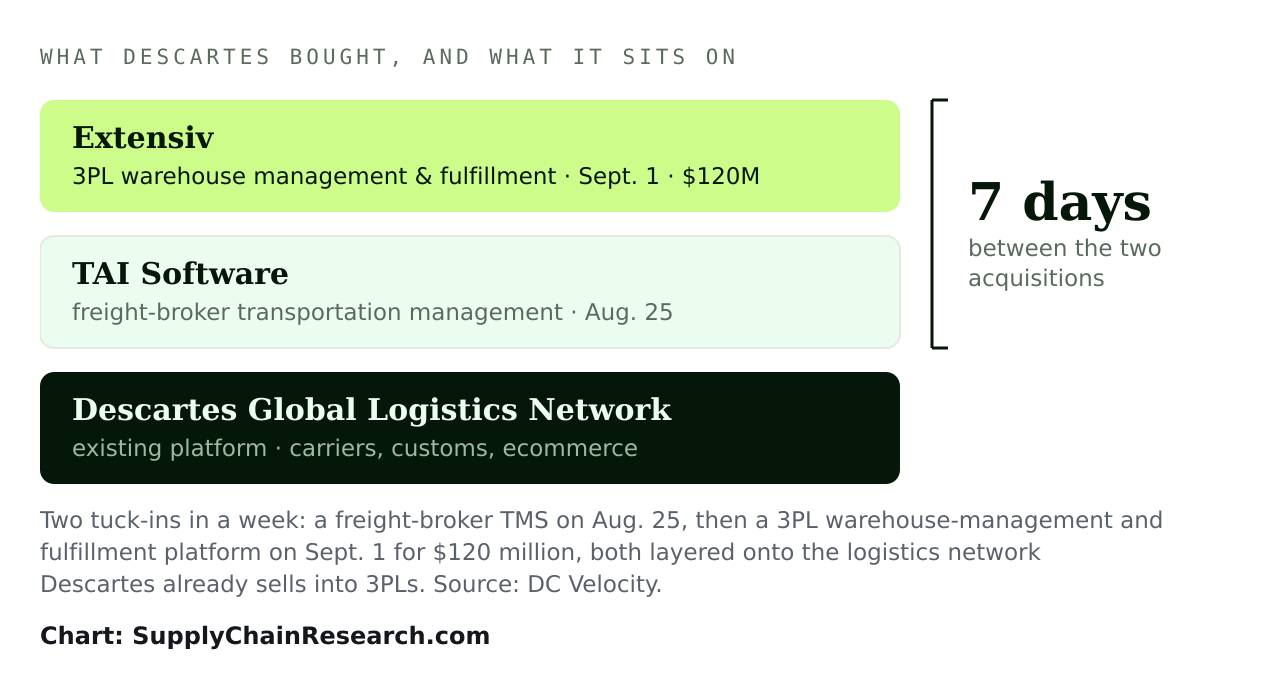
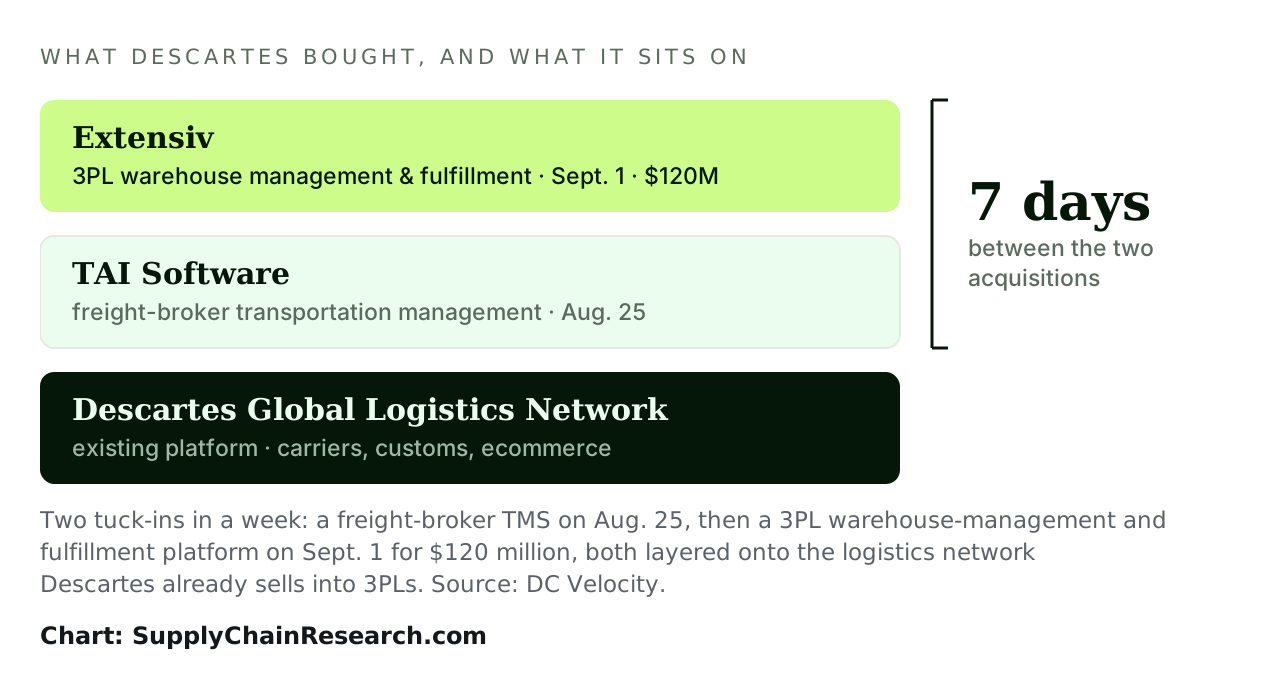
The same appetite showed up in software M&A. Descartes Systems Group paid $120 million for Extensiv, a California-based warehouse-management and fulfillment platform built for third-party logistics providers and the brands they serve — its second acquisition in seven days, after buying freight-broker TMS vendor TAI Software on Aug. 25. Descartes framed the deal as adding “more participants, more contextually rich operational data, and fulfillment intelligence” to its Global Logistics Network. Translated: it is assembling a 3PL-specific stack, one tuck-in at a time, and it isn't waiting for a better market to do it.
Use this chart ↓
Free to republish with a credit link to this article. Download PNG · SVG
For 3PLs already running Extensiv, the practical consequence is a roadmap-and-pricing conversation under new ownership that hasn't happened yet. It's a better moment to benchmark the alternatives in our WMS comparison now than after that conversation lands.
The buildout is physical, too
Kenco is tripling the robotics testing lab at its Chattanooga headquarters from 10,000 to 30,000 square feet, opening Sept. 10 with at least 30 robot types across more than a dozen technologies. The original lab dates to 2015 and, in the words of Ainsley Williams, the company's VP of automation and innovation, simply ran out of room: a single palletizing robot could eat most of it. The expanded floor's first showcase is a near-lights-out sequence — one robot unloads pallets from a trailer at the dock, a second carries them into the building, a third depalletizes the cases — orchestrated by Gray Matter software with AutoStore and GreyOrange systems on the floor. The project Williams singled out as the real prize is random mixed-SKU pallet building, because today's robotic palletizers need cases to arrive in a precise sequence, a constraint that suits automated storage systems and almost no 3PL operation.
The part that matters for buyers is the vendor neutrality. Kenco runs roughly 140 distribution centers and manages the equipment inside them, so it lives with whatever it recommends; a lab built to test how machines from different makers work together is the discipline most operators skip and then pay for on a live floor. Our warehouse robotics comparison covers how the vendors on that floor stack up on their own — integration is the part no vendor's datasheet will tell you.
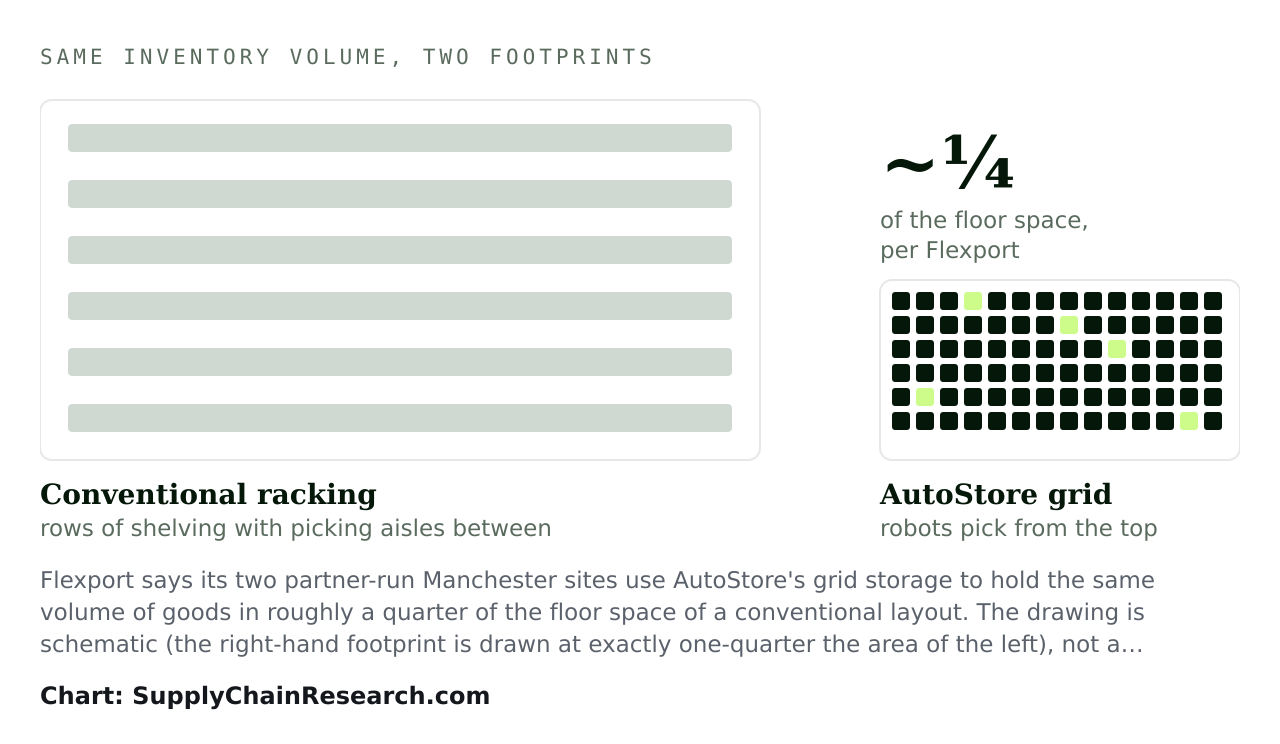
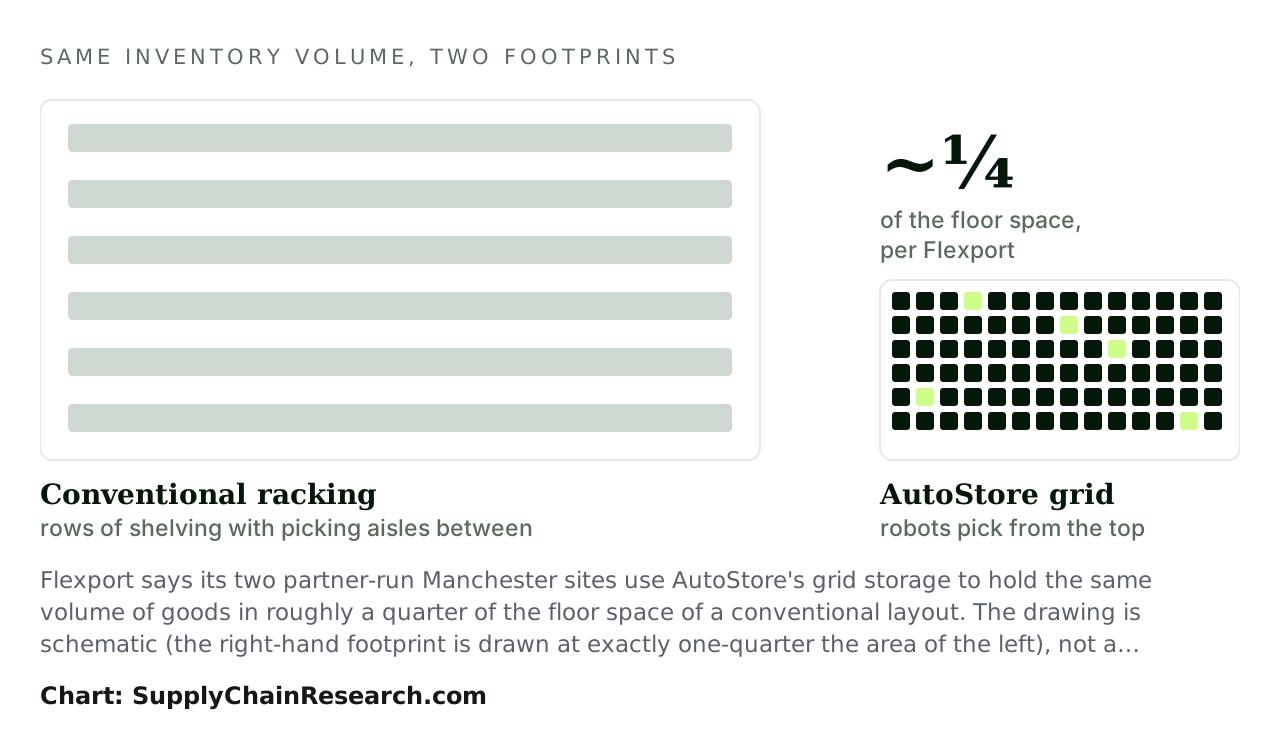
Flexport, meanwhile, opened its first fulfillment operations outside the United States: a Health Canada–certified site in Mississauga, near Toronto Pearson, where receiving began in July and first orders ship this month, and two partner-run facilities in Manchester, England. Continental Europe is slated for 2027. The Manchester sites run on AutoStore's grid storage, which Flexport says holds the same inventory volume in about a quarter of the floor space of a conventional warehouse. Founder Ryan Petersen's line was that customers “built demand in Canada and the UK long before they had a good way to serve it” — but the more honest framing in Flexport's own materials is about tariffs, importer-of-record scrutiny and country-of-origin enforcement pushing companies to hold inventory where it sells. Density is what makes a partner-run overseas site pencil out at all.
Use this chart ↓
Free to republish with a credit link to this article. Download PNG · SVG
That quarter-of-the-floor claim is AutoStore's core pitch, and it is the reason the same system keeps turning up in this issue — on Kenco's test floor and in Flexport's U.K. sites. Our AutoStore profile has the vendor detail.
What the SPAC tells you
Then there's PlusAI, which said Sept. 3 it plans to go public by merging with Texas Ventures Acquisition III Corp., a SPAC backed by private-equity firm Yorkville Advisors Global, in a deal expected to raise about $300 million and fund the company through 2027. PlusAI is running autonomous freight routes in Texas with Ryder and International, and is working with TRATON, Hyundai and IVECO toward a 2027 commercial launch of factory-built trucks running its SuperDrive system.
A SPAC in 2026 is itself a small tell. It reads less like confidence than like private capital for pre-revenue autonomy having gotten harder to raise — which is consistent with the rest of this issue: money is still flowing into automation, but it is getting choosier about the vehicle. The milestone that will actually matter is driver-out revenue miles at scale, not the listing; watch incumbents like Aurora for the real pace, not the funding announcements.
Our take: none of this is contingent on what the LMI does next month. The software side compounds on adoption gaps that exist independent of freight volume; the physical side is being justified by tariffs and density math, not tonnage; and the capital side is still showing up, just through narrower doors. If a warehouse robotics or WMS decision on your desk is being budgeted on the assumption that vendors get cheaper or slower to sell in a decelerating market, this week is evidence against it. Three things worth watching:
- Whether Samsara's AI attach rate holds once the early adopters are through — that, not revenue, is the pricing-power signal.
- What Descartes does with Extensiv's roadmap and pricing in the next two quarters; every 3PL on the platform is now a captive audience for the answer.
- Whether Kenco's mixed-SKU pallet-building work produces something a 3PL can actually deploy — it is the unlock that would open pallet automation to warehouses that don't run an AS/RS.
Watch: AutoStore — Stop Airhousing, Start Warehousing (YouTube, AutoStore's official channel) — the company's own explainer of the grid-storage system behind the quarter-of-the-floor claim above.
The Daily Signal reports from the cited public sources; SCR's takes are its own independent editorial judgement. Supply Chain Research accepts no vendor compensation for coverage.